

In the last century, when breast cancer was mentioned, the most common surgery performed was mastectomy, which involves the complete removal of the breast. However, later studies showed that when it is an early-stage breast cancer, it is possible to achieve the same result with more limited surgical procedures.
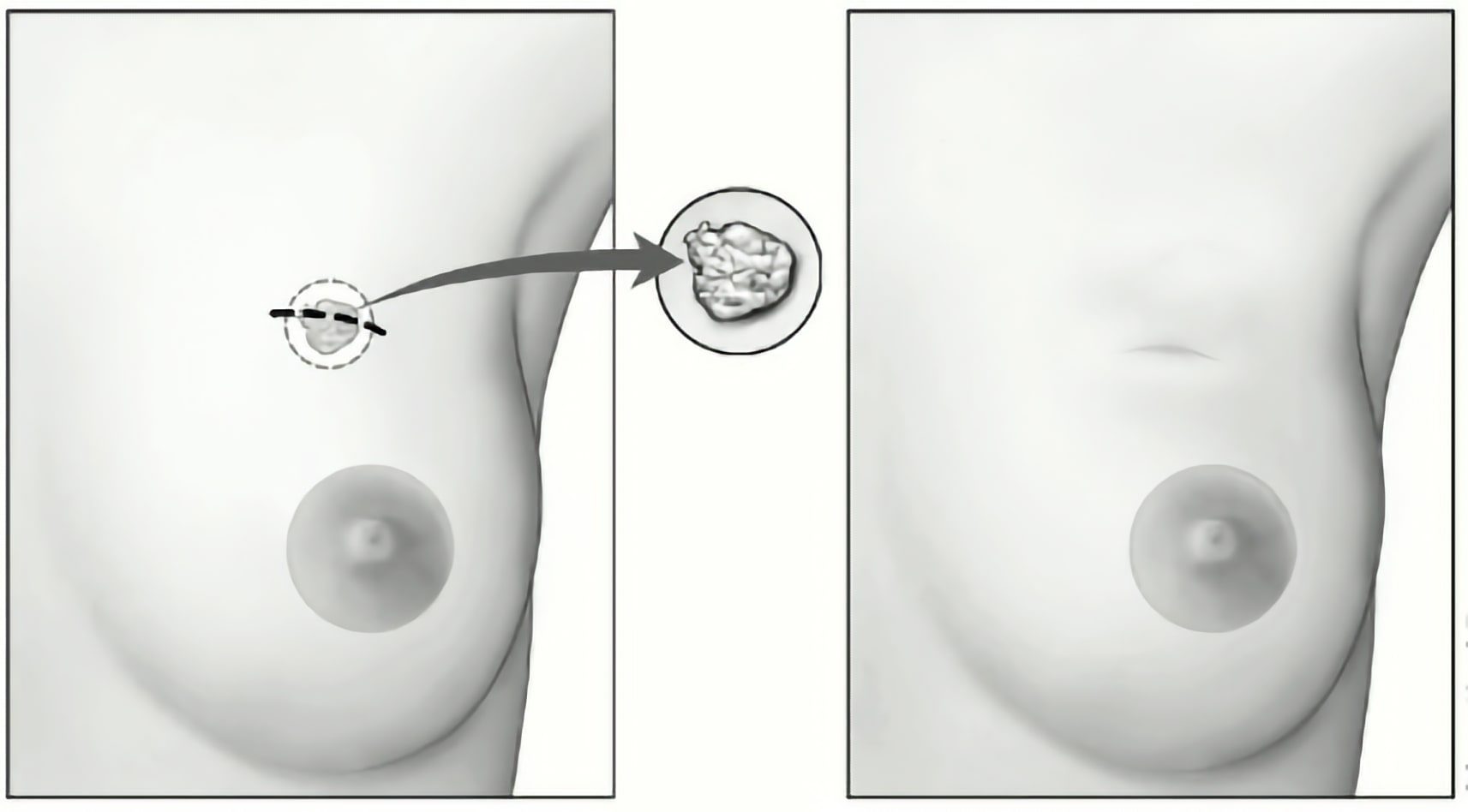
In early-stage breast cancer, life expectancy is already high, so it is possible to both maintain a long life expectancy for the patient and achieve a good cosmetic result with more limited surgery. Here, breast-conserving surgery or, if the tumor is slightly larger, methods called oncoplastic surgery are used.
How is locally advanced breast cancer treated?
Locally advanced breast cancer, as the name suggests, indicates a tumor that has spread to some extent in the breast and towards the armpit. In other words, it represents a step beyond the early stage. Here, rather than surgery, the focus is on shrinking the tumor with additional treatments (radiotherapy, chemotherapy, etc.), and then performing surgery. In these types of patients, even mastectomy, where the breast is completely removed, cannot be safely performed initially.
In a patient who is a candidate for mastectomy, after these treatments, it is also possible to perform surgeries called breast-conserving surgery, where the breast is better preserved and better cosmetic results can be obtained.
In summary, in locally advanced breast cancer, it is necessary to first apply treatments such as radiotherapy, chemotherapy, and sometimes endocrine therapies to relatively shrink the tumor and observe the tumor’s response to these treatments, and then consider surgery.
How is metastatic breast cancer treated?
Metastatic breast cancer is when breast cancer has spread to other organs in the body. Surgery becomes secondary in this situation. Primarily, treatments such as chemotherapy, radiotherapy, and endocrine therapy are used to try to clear the areas where the disease has spread. Surgery targeting the breast is considered at a later stage.
How is inflammatory breast cancer treated?
Inflammatory breast cancer is one of the most serious forms of breast cancer. Here, there are findings such as swelling and redness in the breast, which can be confused with inflammation. The important thing is that when there is swelling, redness, or pain in the breast, it should not be dismissed as just an inflammation.
Even if some treatments such as antibiotics and anti-inflammatory drugs are given to the patient, it is necessary to follow up and have the necessary additional examinations done. If breast cancer findings are detected, the treatment process should change accordingly.
In the treatment of inflammatory breast cancer, primarily non-surgical options (such as chemotherapy, radiotherapy, endocrine therapy, etc.) are applied. First, the disease is partially controlled with these, and then surgical treatment is considered.
What are the surgical treatment options for breast cancer?
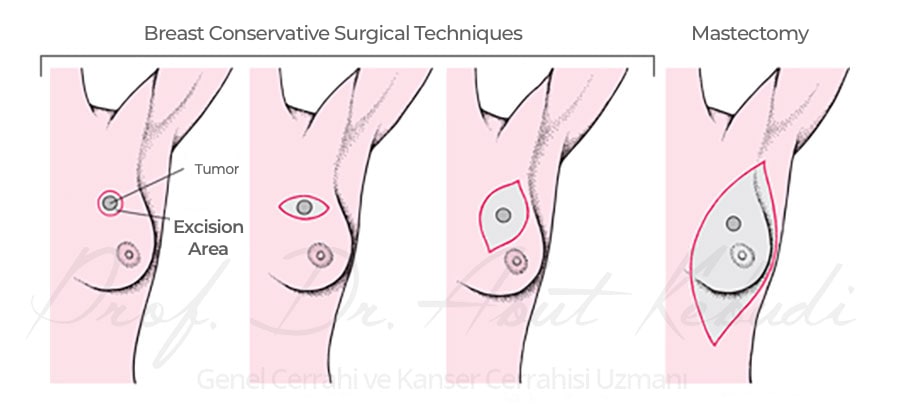
In breast cancer surgery, there are surgical treatments applied to the breast and the ipsilateral (same side) armpit. There have been significant changes in both of these in our current century. From radical surgeries where previously the entire breast, and even the muscles, were removed, today we have reached the level of oncoplastic surgery. In the armpit as well, while the armpit was cleared in every patient in the past, today we have reached options of performing more limited surgery, and even “not performing any surgery” at all.
What is a mastectomy and what is its purpose?
A mastectomy is a surgery in breast cancer where the entire breast is removed. At the beginning of the twentieth century, these surgeries were performed in a very radical way, meaning the breast and the muscles beneath the breast were removed extensively. Today, mastectomies are performed less frequently than in the past.
Scientific studies have shown that extensive breast surgery does not increase the patient’s life expectancy. Therefore, today mastectomy is performed in about 20% of all breast cancer surgeries, although this varies from region to region.
Prophylactic mastectomy is the performance of a mastectomy, either unilateral (one-sided) or bilateral (two-sided), even without the presence of breast cancer. For example, if we remember the famous actress Angelina Jolie, even though she didn’t have breast cancer, because she had a genetic mutation that could lead to breast cancer (in this case, there is a 60-70% risk of developing breast cancer after the age of 40), both of her breasts were emptied while preserving the outer skin. In other words, mastectomy surgery can also be performed for preventive purposes.
What is breast-conserving surgery in breast cancer treatment?
In breast cancer, especially when it is at an early stage, it has been observed that extensive surgery does not affect the patient’s life expectancy. Therefore, with breast-conserving surgery, it is possible to both maintain a long life expectancy for the patient with more limited surgery, and to preserve the appearance of the breast well, that is, to increase the patient’s quality of life.
Breast-conserving surgery can primarily be performed in early-stage cancers. Secondly, in locally advanced breast cancer, after appropriate treatments (such as chemotherapy, radiotherapy, etc.) are applied and the disease is somewhat regressed, breast-conserving surgery can still be performed.
What is oncoplastic surgery in breast cancer treatment?
Oncoplastic surgery is a surgical technique that has developed in recent years and can be defined as a step beyond breast-conserving surgery. While a good result can be obtained with more limited surgery in breast-conserving surgery, oncoplastic surgery aims to achieve good results even in cases where breast-conserving surgery is not suitable, where the tumor is relatively larger. Both the tumor is treated, and a good aesthetic result is obtained.
How should the surgical approach to the armpit (axilla) be in breast cancer treatment?
In the surgical treatment of breast cancer, separate surgeries are applied to the breast and the armpit. This is because breast cancer generally spreads through the lymphatic system, and the first place it usually spreads is the ipsilateral (same side) armpit.
While in the past, the entire armpit was removed in cases of metastatic spread, current studies suggest removing and evaluating the first few lymph nodes involved in the spread of breast cancer during surgery, and determining the approach to the armpit according to the result obtained. If no cancer is found in these nodes, the armpit is not cleared (dissected).
In cases where there is limited involvement, a choice will be made between surgery or radiotherapy. Therefore, surgery performed on the armpit is gradually decreasing.
What is the role of chemotherapy in breast cancer treatment?
Chemotherapy is primarily a drug treatment and is administered by medical oncology specialists. Chemotherapy can be used before or after surgery.
Before surgery, it is used to regress the disease in cases such as locally advanced or inflammatory breast cancer.
After surgery, chemotherapy is given for treatment if the risk of developing metastasis is above a certain level, or if metastasis is already present.
What is the role of radiotherapy in breast cancer treatment?
Radiotherapy is a radiation treatment administered by radiation oncology specialists. The aim here is regional disease control, and it is not a systemic treatment like chemotherapy. It is given to treat the area where the disease is located or an area where metastasis has occurred, such as bone.
The primary goal of radiotherapy is to prevent the recurrence of the disease in the breast, and it is especially used in cases where we perform limited surgery. Radiotherapy is used in patients who have undergone breast-conserving surgery to prevent recurrence.
What is the role of hormonal therapy in breast cancer treatment?
Not all breast cancer cells are hormone-sensitive. In other words, estrogen and progesterone receptors are not always positive. In cases where they are positive, adding hormonal therapy to the treatment is of great importance in terms of the course of the disease.
Sometimes, in locally advanced breast cancers, just as chemotherapy can be administered before surgery, hormonal therapy can also be administered. Or, the patient can be operated on first, and then, while chemotherapy and radiotherapy are administered, if the cell types are hormone-sensitive, hormonal therapy can also be performed. There are also various options in hormonal therapy.
The aim of this is to prevent the effects of hormones on breast cancer cells or to reduce hormone levels, and in this way, to prevent the recurrence of the disease and the emergence of problems.

